"Anything that can prevent you from achieving your performance objective, is a risk that must be managed"

Thursday, 7 May 2015

PwC's FORENSIC REPORT ON NNPC – A JOB WELL DONE

The PwC report on the investigative forensic investigation into allegations of unremitted funds into the Federation Account by NNPC, recently released by the Office of the Auditor-General of the Federation has generated a lot of discussion.  A key component of the interest has been the caveat included by PwC in its report, and the impact that it might have on the applicability of the findings in the report.

I have read some of the comments in the papers challenging the manner of reporting by PwC and the inclusion of the caveat.  I had initially dismissed some of these articles as being largely pedestrian and lacking in depth until I realized that some the writers have quoted “reliable sources” including in some cases senior partners in small and medium firms of auditors (SMP's). Could these partners in some of these small and medium firms of accountants then be this ignorant or was this a deliberate attempt to misinform the public? We know that the big four firms are sometimes seen as unequal competition. Either way, these comments are capable of undermining our noble profession that we have worked so hard to build. Hence as a seasoned accountant having trained with PwC myself years back and now running my own practice, I feel constrained to educate the public as well as my fellow accountants on certain basic reporting concepts provided by the International Federation of Accountants in its various publications.

What PwC stated in its report
PwC stated in its report that “the procedures we performed did not constitute an examination or a review in accordance with generally accepted auditing standards or attestation standards. Accordingly, we provide no opinion, attestation or other form of assurance with respect to our work or the information upon which our work was based.”

What is an Opinion, Attestation, Assurance?
According to the International Framework for Assurance Engagements contained in the International Federation of Accountants (IFAC) Handbook of International Quality Control, Auditing, Review, Volume II 2014 Edition Volume II (which is available to all accountants) an assurance engagement is one where a practitioner expresses a conclusion designed to enhance the degree of confidence of the intended users other than the responsible party about the outcome of the evaluation or measurement of a subject against criteria. The framework specifies that five elements exhibited by assurance engagements as three party relationship, a subject matter, criteria, evidence and an assurance report.  There are two forms of assurance engagements  based on the form of conclusions. Firstly a limited assurance engagement in which the accountant expresses his conclusion in the negative form for example  “Based on our work described in this report, nothing has come to our attention that causes us to believe that internal control is not effective, in all material respects, based on XYZ criteria”. Limited assurance is used for example in review engagements such as review of interim financial information. The second form is a reasonable assurance engagement in which the accountant asserts his conclusion in a positive form for example “In our opinion internal control is effective, in all material respects, based on XYZ criteria..” The Audit opinion is included in an Audit report.

IFACs Assurance Engagements other than Audits or Reviews of Historical Financial Information, defines Attestation engagements as an assurance engagement in which a party other than the practitioner measures or evaluates the underlying subject matter against the criteria.

Why I think NNPC did not contract PwC to provide Assurance 
An accountant cannot provide assurance until all five elements that I have enumerated above are present. From just a casual review of the report, I can conclude that a three party relationship (1.Practitioner:PwC, 2. Responsible party:NNPC, 3. Intended user:Auditor General's office),  existed and that there is a definite subject matter (Crude Oil revenues generated by the NNPC). I’m certain though that NNPC would have struggled to provide a clear criteria to PwC. For engagements reporting on compliance, relevant criteria would be things like applicable laws, regulations and contracts, those criteria have to exhibit all characteristics of; relevance, completeness, reliability, neutrality and understandability. From the PwC report, I can see NPDC did not provide access neither was Kerosene subsidy regulation clearly available. Limitations around access to NPDC would have limited the ability to generate complete reliable evidence so I can readily see why NNPC could not have contracted an Assurance engagement with PwC as they could not guarantee the presence of all five elements of Assurance engagements.


Why structuring the investigation as Forensic Audit makes sense
The free online business dictionary that I regularly use defines Forensic Audit as “The application of accounting methods to the tracking and collection of forensic evidence, usually for use in the investigation and prosecution of criminal acts such as embezzlement or fraud. It is also called forensic accounting.

I found that the US Public Company Accounting Oversight Board (PCAOB) Strategic Advisory Group panel discussion observed in 2007 that “Although forensic audits may examine financial reporting and internal control matters, the objective of a forensic audit is not expressly articulated in an established set of standards. Rather, users of forensic audits (e.g., audit or special investigative committees, management, and regulators) establish their objectives on a case-by-case basis.”

It therefore makes sense to me that the probable reason the engagement was structured by the Auditor General as a Forensic Audit which is a type of Non assurance engagement was to give NNPC the flexibility to establish its objectives for the PwC Forensic Accountants as is expected in an investigation of this nature.

What were PwCs Terms of reference?
The report quotes the terms of reference per their engagement letter of  5th June  2014 as follows:
a) Analyse and comment on submissions made by various parties in respect of  alleged remittance shortfalls.
b) Analyse all submissions made by key stakeholders in relation to these unaccounted funds
c) Produce an independent forensic investigation report

Given the enormous findings by PwC in this report despite obvious constraints, my personal view is that PwC adequately discharged their duties under the terms of reference given to them. This exercise should not be a one- off, but should be done regularly by them every few years and at least once during every administration perhaps targeting other areas not investigated in the current exercise. Indeed a Public Company Accounting Oversight Board (PCAOB) in the US November 2006 paper posited the idea of regular forensic audit as a way to improve detection of fraud at public companies and enterprises.  Indeed the new administration should re-engage PwC with wider terms of reference and with unlimited access and if so desired commission an “assurance” engagement.

Fuss over the Caveat …Much ado over absolutely nothing…
Accountants are in fact required to include such caveats when reporting on non assurance engagements. International Framework for Assurance Engagements paragraph 15 on 'reports on non-assurance engagements', states that a practitioner reporting on an engagement that is not an assurance engagement within the scope of this Framework, clearly distinguishes that report from an assurance report. So as not to confuse users, a report that is not an assurance report avoids, for example:

  • Implying compliance with the International Framework for Assurance Engagements, International Standards on Auditing, International Standards on Review Engagements and International Standards on Assurance Engagements.
  • Inappropriately using the words “assurance,” “audit” or “review.”
  • Including a statement that could reasonably be mistaken for a conclusion designed to enhance the degree of confidence of intended users about the outcome of the evaluation or measurement of a subject matter against criteria.

I am convinced that all responsible Accountants worldwide producing forensic audit reports or any other type of non assurance report are expected to (and presently actually do) include similar caveats so as not to misinform the public. This does not take anything away from the content, value and applicability of the report themselves but only protects users in compliance with IFAC provisions.


Conclusion
In conclusion and in line with the terms of reference, readers of the report should be asking

a) Did PwC analyse and comment on submissions made by various parties in respect of alleged remittance shortfalls? The answer is an obvious “Yes”
b) Did PwC analyse all submissions made by key stakeholders in relation to these unaccounted funds? The answer is an obvious “Yes”
c) Did PwC produce an independent forensic investigation report? The answer is an obvious “Yes”

Given the views communicated by some senior audit partners in some of these SMP's, I think this underscores the need for continuous education on accounting, auditing and reporting and I  have cause to thank God once again for my quality training and background.

I believe this piece lays to rest the matter of the caveat which is in my view, probably a deliberate, needless diversion of the unassuming public away from the core issues raised in the PwC report - Issues that along with the passage of the Petroleum Industry Bill (PIB) should be on the fore-front of everyone’s mind at this time of dwindling revenues.

By Ijeoma Rita Obu (FCA)
Managing Partner 
IRO & Partners Chartered Accountants
Lagos
www.iro-accountants.com


Thursday, 29 January 2015

MANAGING THE RISK OF ENTERPRISE NIGERIA- WHAT JONATHAN AND BUHARI NEED TO KNOW


As the Nigerian elections draw near it is time to look beyond the election itself to governance in the next four years. A May 27th 2013 article published by This Day Live on its website and titled "Ministerial score card towards May 29th" examined the performance of the current government of President Goodluck Jonathan by evaluating the performance of his ministries under the ministers, who are responsible for delivering on his transformation agenda.

The writer rated the ministries using a qualitative rating scale; ranging from the best performance of 'Good' through 'Above Average', 'Average but promising', 'Average' to 'Below Average' and 'Poor'. Reproduced below in table form is the rating assessment. I have taken the liberty of assigning numerical scores to his rating scale to enable a quantitative assessment.

S/N MINISTRY GOOD ABOVE
AVERAGE
AVERAGE
BUT PROMISING
AVERAGE BELOW
AVERAGE
POOR


Score
6
5
4
3
2
1
1 Aviation 6


2 Defence

5


3 Interior


1
4 Finance

5


5 Transport

5


6 National Plann.


3


7 Petroleum

5


8 Power


4


9 Trade & Inv.

5


10 Environment


3


11 Culture & Tourism


3


12 FCT

5


13 Special Duties Not Decided Not Decided Not Decided Not Decided Not Decided Not Decided
14 Communications & Technology


3


15 Education


2

16 Justice

5


17 Niger Delta


2

18 Labour


3


19 Youth Development


2

20 Foreign Affairs

5


21 Works


4


22 Agriculture

5


23 Information

5


24 Sports


4


25 Lands & Urban


3


26 Police Affairs


2

27 Water Resources


3


28 Health


3


29 Mines & Steel


2

30 Science & Tech


2


Total = 105 6 50 12 24 12 1

Total Score of 105
Maximum scores obtainable= 180
Scaled score =58.33%

The majority of citizens eyewitness opinions (5 out of 9 commentators as at 28th Jan 2015) as recorded by commentators on the article on This Day's site was that the assessment was generally fair and comprehensive overall. There were a few disagreements as follows; 2 out of 9 commentators felt that Education deserved a higher score, 1 out of 9 commentators felt that Mines, steel and solid minerals deserved a higher score and 1 out of 9 commentators felt that only Aviation had done well. The general sentiment was that ministers performing below average without substantiated reasons should be dropped from the cabinet.

My questions are the following; if we accept that performance rating of the Jonathan administration was 58.33% as at May 2013, what was the target and on what basis is that measured and evaluated? Are citizens measuring government on the basis of agreed performance contracts and targets? Did the citizenry have some input in the choice of performance measures? Were quality of life indices included in the key performance measures for each ministry? What is the quality of objective setting? Is the evaluation in line with performance indices earlier set? More importantly what is the explanation for variances and MOST importantly what were the identified risk factors and what plans were put in place to manage the risk inherent in achieving our corporate objectives? As we all know, "anything that can prevent you from achieving your objectives is a risk that must be managed".

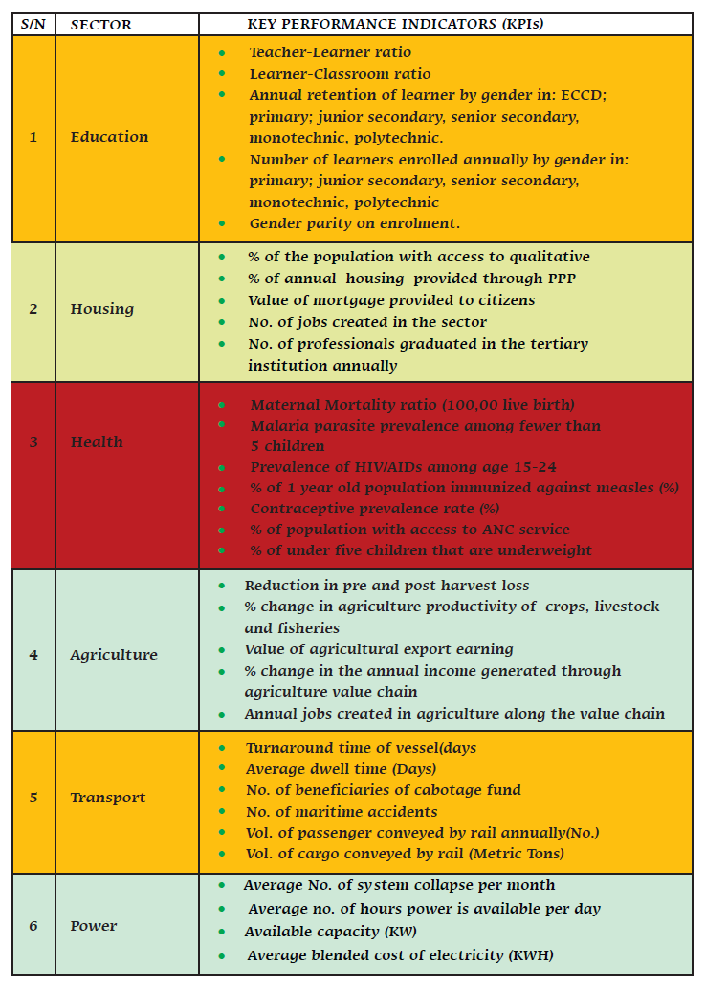
Reproduced below are the top 15 Key performance indicators as disclosed in the 2012 National Planning Commission (NPC) performance Monitoring Report


For the reason that anything that can prevent you from achieving your objectives is a risk that must be managed, I visited the website of the National Planning Commission to find out how performance and risk are measured and managed. I was particularly interested in the department of Monitoring and Evaluation to see what early warning signals they are monitoring and evaluating to determine when triggers for key Risk Indicators are being pulled.

My first discovery is that no where in the objects clause is the measurement, management, monitoring or evaluation of risk mentioned. I have reproduced the objects clause below.

"Monitoring and Evaluation

The purpose of this department is to improve the availability, quality and dissemination of government performance information for accountability and policy improvement purposes.

The functions are as follows:

Develop and maintain a framework to support the monitoring, evaluation and reporting of government performance at the national and sub-national levels, in line with the national development goals and objectives; Monitor and evaluate government performance at sectoral level (to measure performance of government policies in each sector of the economy), institutional level (to measure performance of government institutions) and program level (to evaluate the effectiveness and impact of public programs); Develop and publish the Nigeria Country Report as the primary medium for the dissemination of performance information; Develop evaluation capacities across government at the federal and state levels to ensure that the quality, results, and
impact of programs and expenditure can be measured at reasonable cost;Collaborate with MDA's to develop results-focused, key performance indicators and clearly defined performance targets upon
which progress will be measured; Develop the data management system for the National M&E system, including data collection tools, identification of data sources, frequency of data collection and data transmission plan;"

I then reviewed the most recent National Planning Commission Performance Monitoring Report available on the website being that for 2012 to see how risk was reported. To my surprise again, in no section of the report was risk management addressed. To their credit, section 4 analysed the key strategic goals and the enabling conditions identifying KPI's but without identifying potential risk events and developing KRI's for them.

Risk management is an essential tool in tackling the uncertainty associated with any enterprise. Entities be they corporate organisations or nation states have always practiced some form of risk management, implicitly or explicitly. Enterprise Nigeria must be practicing some form of risk management, but it is clearly unstructured , not systematic, not holistic, not properly linked to performance and not integrated properly across policies and across Ministries, Departments and Agencies responsible for governance.

Nigerians are known to be very good at planning but not so good at implementation. From my review and analysis it would appear that Nigeria's main problem is a failure to Manage Risk Enterprise-wide and systematically..

MY RECOMMENDATION
Whoever wins this election should improve on the progress already made and the good work already done to date. This improvement should be by incorporating into NPC's object clause the enterprise-wide management of risk for Nigeria. Nigeria should deploy an Enterprise-wide Risk Management (ERM) framework and structure complete with three lines of defence. Ministries and ministers should also inherit Key Risk Indicators (KRI's) in addition to KPI's, which their performance should be measured against. If this is done we will have better achievement of targets and risks adequately mitigated, be they political risks, macro-economic risks, security risks, environmental risks, legal risks, social risks, financial risks, or regulatory risks et cetera,will would be routinely and properly managed preventing unwelcome surprises.

Author

Ijeoma Rita Obu, FCA, FIMC is the Managing Partner of Ijeoma Rita Obu & Co. (Chartered Accountants) and the CEO of Clement Ashley Consulting. For comments questions or enquiries regarding this article please send mail to robu@clementashleyconsulting.org or post a comment on her blog riskmanagementandperformance.blogspot.com


Thursday, 4 December 2014

Bank of Industry (BOI) appoints Clement Ashley Consulting as approved Business Development Support Provider (BDSP) in the Zonal category

In a bid to address challenge of access to credit for SMEs, and to hasten the credit delivery process, the Bank of  Industry (BOI) has signed service agreements, engaging 122 Business Development Service Providers (BDSPs) to increase SMEs’ capacity to apply for and secure financing from the Bank.

Speaking at the event, the Managing Director/CEO, Bank of Industry, Mr. Rasheed Olaoluwa stated that this move had become imperative because even though SMEs  account for over 90% of the companies in Nigeria, account for half of the nation’s GDP, and provides employment for more than 30% of its populace, many SMEs have not been able to attract funding because of poorly packaged and non-bankable business plans and proposals submitted to secure funds.

He added that this strategic partnership with BDSPs was in furtherance of the Bank’s core mandate “of providing long-term financial and business support services to large, medium and small projects”. He also pointed out that this would also help the Bank fulfill its obligations towards the success of the National Enterprise Development Programme (NEDEP), of which the Bank is a key stakeholder.

Mr. Olaoluwa revealed that the selection process that brought about the 122 BDSP firms was rigorous and that the selected companies were placed in three categories, based on their capacity and preferred areas of coverage. BDSPs with a national coverage totalled 28, regional coverage BDSPs were 74 (of which Clement Ashley Consulting is one of the seventy four, and covering the South West, South South and South East zones), while state-focused BDSPs were 20 in number. "

If you are located in the South West, South South and South East Regions and wish to make any enquiries about access to funding please send mail to robu@clementashleyconsulting.org

Best Regards
The Business Development Team
Clement Ashley Consulting
017925490, 08080642478

Thursday, 17 April 2014

Managing the Risks of Recruiting

Introduction

On the 15th of March 2014, the Nigerian Immigration Service (NIS) carried out a pre-recruitment aptitude test nationwide. Over 500,000 (five hundred thousand) job seekers were attending these tests to compete for less than 5,000 (five thousand) vacancies. This means that the ratio of applicants to jobs was more than 100 to 1. At this test there were stampedes at several centres and as at the last count eighteen young Nigerians had lost their lives with scores wounded. Several others lost their lives in traffic accidents on the way to and way from the test venues. I surmise that there is a better way for the Government to recruit while managing the risks of recruitment.

The unfortunate stampede which led to the deaths of several job candidates seeking to join the Nigerian Immigration Service, is a tragedy on many levels and an avoidable one at that.

Firstly it is a tragedy for the families of the young men and women who died. Families that were hoping for these young people to come home with good news of a successful interview not to be called to identify their loved ones in the morgue.

It is also a tragedy for the image of Nigeria. The most populous country in Africa with the now (re-based) largest economy in Africa. It should not be seen to be failing to provide sufficient opportunities for our young people to be gainfully employed. The sheer number of candidates in the stadia was astounding and clearly indicates that a lot more needs to be done to create jobs for our school leavers. More importantly for the subject of this paper is the fact that the exercise was conducted without any regard for risk management.

I was moved while watching the news of this sad event to hear a traumatised victim asking why in this modern times the recruitment was done in such a manner. This is a question that is no doubt being asked up and down the country and lessons need to be learned.


Problem Statement

In the past government agencies and the Nigerian military and paramilitary services have seemingly held the view that candidates need to be seen to be screened. Note that I use the word screened (not interviewed). Following from this logic; to screen 500,000 you need to see 500,000 physically. The problem is that seeing 500,000 persons at the same time is a big risk. Asking 500,000 person to physically appear which involves travel even if not on the same day also involves huge risks. These are risks that the recruiter should manage and mitigate and not pass on to the hapless job seeker. The attitude of the Nigerian Immigration Service and its “recruitment consultant” seems to be “please come at your own risk”.


Previous Options


At this last screening and recruitment exercise the Nigerian Immigration Service actually used an online platform to receive applications and collect the application fee. After this the candidates were required to report at various stadia for written aptitude tests. The question is; “why stop the use of technology at application collection?” Why not use the online platform to organize online testing.

Clement Ashley Consulting's Solution


  1. Use an online platform to collect applications- this saves time, manages the risks of travel as well as missing or misplaced applications as well as the risk of wrong recording of names and other candidate details. Also aids data mining and shortlisting.
  2. Abolish the practice of collecting application processing fees from candidates responding to your job advert. This is not only unethical but abolishment also removes the risk of exploitation as well as profit induced risky practices and a risk prone mindset such as “the more the merrier”
  3. Use online aptitude and job knowledge tests to screen and shortlist for further screening, this addresses the risk of looking further at persons who lack the basic knowledge and intelligence for the job. It also addresses the risk of travel, queuing and crowd control. Any concerns about the sanctity of online test can be addressed by Information Security methodologies.
  4. Use online psychometric and personality tests to screen and shortlist for further screening and/or interview. This addresses the risk of looking further at persons with the wrong personality or mindset. It also addresses the risk of travel, queuing and crowd control and saves the time of the interviewers.
  5. Use a recruitment software application to move candidates application down the recruitment funnel from one stage to another this saves time and money (the cost of personnel) and the need for physical file carrying with the attendant risk of manipulation.
  6. Only invite candidates for final interview when the ratio is down to less than or equal to: five candidates per vacancy,, anything more than that is unreasonable.
  7. Only carry out medical or other physical tests during or after the interview, if a pre-condition for employment then combine with final interview to minimize travel, cost of examination and queuing.


Clement Ashley Consulting recommends that job seekers be treated with respect. As part of quality control this proposed recruitment methodology should be audited regularly for compliance.

Benefit 1

Using this approach recruitment is faster. Marking of scripts that could take weeks will be accomplished instantaneously.

Benefit 2

Using this approach recruitment is cheaper. Only a few hands will be necessary to manage an automated recruitment process.

Benefit 3

Using this approach recruitment will be less risky for the applicants as travel, queuing and the need for crowd management will be reduced or eliminated.

Benefit 4
Using this approach the recruitment process will be transparent leading to more credibility for government agencies or other large scale recruiting organisations.

Summary


Technology based recruitment in the 21st Century is a minimum standard requirement for large scale recruitments. Anyone reading this, will be forgiven for wondering why this paper is necessary.

Wednesday, 5 February 2014

Managing the Risk Within: Employee Fraud Prevention and Detection

Introduction


Fraud costs American businesses, large and small, a ton of money each year. In fact, according to the McGladrey report The Threat Within: Employee Fraud Detection and Prevention, fraud took a huge toll on American businesses, to the tune of nearly $1 trillion dollars, last year. The problem only seems to be worsening with the volatility of the economy. That’s why it’s so important to focus on prevention rather than trying to recover losses after the fact.

In Nigeria where data and statistics are scarce one can safely assume that Nigerian business are losing much more than that. In the last couple of years we have seen departments, units and entire businesses close down due to employee fraud and unethical behaviour. A few cases can illustrate this. A hospital had to close its laboratory because the laboratory technicians were no longer doing the hospitals work but were taking in 'unrecorded' work from other hospitals for a fee that the staff privately pocketed. Patients of the hospital who were used to a 3 day return appointment were now having to wait 3 weeks, meanwhile the lab was always stocked out of required materials previously purchased, and still unused, as far as the records showed.

The hospital could not cope and decided to close the laboratory. It laid off all the workers and now send their work to laboratories abroad.

You may have heard of workers diverting their employers goods in containers, diverting tankers of petroleum products or selling the employers goods worth hundreds of thousands of Naira without issuing official receipts. We have even heard of a case where all the fish in a fish farm mysteriously disappeared just before harvest. The list of such worker related fraudulent behaviour is endless. The Great American Insurance group who provide business crime Insurance coverage in the US, say that Employee fraud costs companies a surprisingly large percentage of their gross revenues. With some employee fraud schemes spanning years, the results can be devastating to a company's operations and its financial results.”

Small businesses are even more vulnerable to employee theft because they lack the level of internal control and security that larger businesses often have in place. For these reasons, you need to work now to come up with an effective method for deterring employee fraud and theft.


Problem Statement

In the past we could rely on young people to learn ethics at home, re-enforced by schools and canonized by churches, mosques and religious institutions. This is no longer the case. Little Johnny the son of a reverend pastor and a teacher mother, 'hears' his father preach that stealing is a sin. He then 'sees' the same father dip his hands into the offering bucket. He listens to his mother teach that stealing is wrong but then he sees her bring home exercise books and pencils form the school for his private use at home. Johnny gets to university and his lecturers are not in class because they are busy running their private businesses during school hours. In fact some of his lecturers engage him to run errands for their business when his class should be holding. He obliges so that he can get a pass mark when exams for which they are not being prepared, come up, as they must.

Having passed through these experiences the grown up John graduates and because of his high IQ he passes your recruitment test and is offered a job. John who is about to resume at your company is the same person that switches on his TV set at home to see that some leader; political, corporate, religious or social has just been indicted for committing economic crimes. While the case is still on, he sees this same person receive national awards and traditional titles in recognition of his 'contributions' to his community and nation.
This is the practical lesson in 'ethics' that John has learned.

Previous Options


In many organizations, 'on-boarding' or 'induction' is all about getting the new employee to learn the ropes as fast as possible. The company trusts that their list of do's and don'ts as contained in the staff handbook is sufficient to guide the new employee as far as what is acceptable behaviour to the organisation is concerned. To make assurance doubly sure the new employee is asked to sign a copy of the staff handbook to acknowledge that he has read and understood the contents of the handbook. The company is satisfied that this aspect of his induction has been taken care of and they now concentrate on the 'business' of doing business itself.

Clement Ashley Consulting's Solution


  1. Require Employees to Take Vacation
  2. Train Managers and Employees to Spot Fraud
  3. Implement Internal Control Systems
  4. Create a System of Internal Audits
  5. Conduct Background Checks on New Employees
  6. Invest in Business Crime Insurance e.g. Fidelity bonds
  7. Encourage anonymous whistle-blowing
  8. Train Employees on Employee Work Ethics and Responsibility


Clement Ashley Consulting recommends that as part of induction, new personnel be taken through a course on 'employee work ethics and employee responsibility' in the context of the organizations operations. Having facilitated this kind of training before, we are sometimes shocked during pre-case quizzes at what employees ignorantly defend as acceptable behaviour, when practical case studies are being handled in workshops and training classes. These practical case studies give the employer the opportunity to work through myths and wrong beliefs and replace wrong values with the right ones.


We believe that this should not be a one-off exercise. At least once every two years all staff should have a refresher on workplace ethics with an emphasis on the discussion of industry specific case studies to reveal any new mendacious thoughts and beliefs, and nip them in the bud.

When training on work ethics for staff is combined with adequate internal controls, segregation of duties, independent audit and examination as well as a well designed reward and compensation scheme that is tied to performance management and appraisals, the company stands to attain competitive advantage over its peers who do not properly address the issue of employee work ethics.


Benefit 1

Using this approach training is focused is on corporate goals and objectives, providing the best possible environment for achieving them.

Benefit 2

Using this approach you will be able to identify any wrong interpretations of what is ethical and hence prevent unethical behaviour

Benefit 3

Using this approach you are able to build a core of ethical staff who can resist a 'renegade thinker'. It is well known fact that collusion can override the best of controls. Wide spread training on ethics for all staff, reduces the risk of collusion.

Benefit 4

Using this approach you are able to reduce operational losses due to employee related unethical activities. Training on employee work ethics pays for itself many times over in reduced operational losses.

Summary


Training your staff on employee work ethics and employee responsibility is something that can give your organisation competitive advantage. As everyone knows when something becomes scarce it becomes a source of value. With widespread corruption and unethical behaviour as the order of the day. Your organisation will reap enormous benefits form having an ethical workforce.

Thursday, 23 January 2014

Managing the Risk of Headhunting

Introduction

Eighty percent (80%) of business success is tied to people. Recruiting the right people, motivating the right people, training the right people, retaining the right people while releasing the wrong ones is the key to your success. Many business under-perform because they do not know to do this or they can’t do it well. Anything that can prevent us from achieving our objectives, is a risk that must be managed. Therefore if we want to hire the right people we must manage the risk of getting it wrong.

Problem Statement

Identifying the right talent is always a concern. Some employers figure- 'why try to reinvent the wheel'. If some other company is getting it right, then why don't we just identify the person responsible for success and get him or her to join our team

Previous Options

Current practice in most business organizations is that when they think this way, they turn to their HR manager or their HR consultant and ask them to head hunt a certain person occupying a target position in a target company. Many employers think that getting the person responsible for success at company 'X' will translate into success at company 'Y'.

This is not always the case. Let's look at a sample scenario to explain why. Company 'Y' identifies company 'X' as having the kind of market share and sales performance that they would like for themselves. They identify the Head of Sales and Marketing in company 'X' and decide that if they can just get to recruit him/her. He/she would in no distant time work his/her magic on their numbers. What they failed to realize is that the CEO of company 'X' is an excellent networker who is always passing qualified leads to his sales team. Eighty percent of qualified leads come from the CEO, in addition the head of sales and marketing has a couple of fantastic 'closers' on his team this duo have a conversion rate of close to 90%. Company 'Y' does not have this same ideal situation.

The new Head of Sales and Marketing resumes at company 'Y' his strength is in managing a sales process. He duplicates the exact same sales process he used at company 'X' but with dramatically different results.


Clement Ashley Consulting's Solution

Clement Ashley Consulting recommends a recruitment approach that takes account of the problems identified above. We recognize that in reality the success you see may be as a result of a myriad of factors, some inimitable; the structure, the processes, the people, the life cycle of the organisation, the synergy of a team etc etc.

This means that we cannot assume that because the Head of Sales and Marketing recorded success at company 'X' he will automatically record success at company 'Y'. We still need to investigate his performance and validate his results. A head hunting approach does not give us the opportunity to do this. The target always feels like the 'beautiful bride' ask him to take a test or survey and responds 'do I have to do that, you know I am a performer that is why you approached me'. The target gives you the run around, always playing hard to get. The meeting is less of an interview and more of a salary negotiation from his point of view. What you hear is “ I am very happy where I am, and if you want to get me to leave, you need to make me an offer I cannot resist” As a result you end up paying a salary three or more times what you would have paid if you allowed him to compete for the position.

Please read Bernard Marr's Linkedin article Who's Been Paid $109 Million For NOT Performing At Their Job?” to learn how Yahoo Inc paid a whopping sum of $109 million for 15 months of non performance when they headhunted De Castro of Google. Please follow this link to read.Headhunting at Yahoo


Our approach begins with understanding in great detail who exactly the man or woman for the job is. We recommend that you elicit a very detailed job description for each position and then make a very detailed and thorough man specification for each job description Armed with this you are now in a position to write a compelling copy for an advert that is geared to attract only the people who are actually qualified and discourage speculative job seekers. Having attracted the right targets, you should now put them through a thorough testing process to validate their IQ, work skills, job knowledge, emotional stability and personality fit for the job. If you have any headhunting target in mind encourage them to apply in response to the advert. If your advert copy is well written, chances are they would already have applied if they saw the advert. Let him compete with other applicants. This gives you an opportunity to independently validate his claimed successes. It also gives you an opportunity to hold him accountable for results in order to earn whatever salary is finally agreed. As you know competition always brings prices down. The same goes for salaries.

Benefit 1

Using this approach you greatly reduce the run around you get from headhunt targets.

Benefit 2

Using this approach you will not get hood winked by successes for which the candidate is not solely responsible and therefore cannot replicate

Benefit 3

Using this approach you are able to negotiate a competitive salary and hold the candidate accountable for results and not pay three times what the candidate is worth for success claimed elsewhere.

Benefit 4
Using this approach you do not limit yourself to what you think is available but create an open playing field that enables you discover other potential talent at a reasonable price.

Implementation

Implementation involves designing recruitment policies and procedures that standardize these best practice methodologies .It involves recognizing what personalities suit what jobs and identifying the right tests to administer. It involves understanding performance measures for each job position. It involves advertising for all positions; headhunting just becomes one approach of sourcing applicants to apply.

Summary


Hiring the right staff is the best thing you can do for your organisation. Jack Welch says 'Get the right people in the right jobs – it is more important than developing a strategy' The eighty-twenty rule recognizes that eighty percent of business success is tied to people but only twenty percent of organizations get it right. You can be part of that top twenty percent.

Technorati S9969AXG6QNZ 

Tuesday, 24 September 2013

Risk Based Internal Auditing - The New Approach

Introduction


The Institute of Internal Auditors defines Internal auditing as an independent, objective assurance and consulting activity designed to add value and improve an organization's operations. It helps an organization accomplish its objectives by bringing a systematic, disciplined approach to evaluate and improve the effectiveness of risk management, control, and governance processes. (2013).

Problem Statement


If you entered the Internal Audit profession twenty or thirty years ago you would not recognize the above definition of internal auditing. The fact is that Internal Auditing has changed significantly over the last decade. Much of those changes have been driven by new regulation and regulatory demands, new technology, new professional standards, globalization  new ways of working especially the need for collaboration as well as a more proactive, dynamic and risk based approach to auditing. The fact is that many career auditors need to re-tool, re-think and re-train to carry out their new expanded responsibilities effectively.

Previous Options


In the old traditional, conventional approach to auditing. Internal auditing was a compliance based activity. The traditional internal auditor armed with his checklists, standard audit tests and annual audit plan felt capable of providing assurance to management that internal controls were working effectively and that all assets had been safe-guarded. With the role of the internal auditor being redefined in line with the introductory definition above, more is needed for the Internal auditor to be able to help his organisation accomplish its operational objectives while improving the effectiveness of of risk management, control, and governance processes, by his objective independent consulting activity.

Clement Ashley Consulting's Solution


Clement Ashley Consulting recommends a Risk Based Internal audit approach that has a business focus rather than an audit focus. The Risk based approach should have a process forcus rather than a transaction focus, it should focus on improvement of risk identification rather than compliance for compliance sake. The risk based approach to internal auditing should use open questioning techniques rather than the traditional closed questioning. The mindest of the risk based internal auditor should be one of change facilitation to improve performance rather than policy adherence.The risk based internal auditor should see himself as a consultant rather than a policeman, if he holds himself accountable for performance improvement results, he will be seen as adding value and not as a cost center  this in turn will enhance his ability to move into other management positions. The risk based internal auditor should be more interested in the future than the past and therefore be more proactive and less reactive. The risk based internal auditor should focus on solutions rather than problems and hence major on performance rather than conformance.

Benefit 1

A risk based audit approach maximizes the use of scarce internal audit resources.

Benefit 2

Using the risk based approach you will have the ability to identify new and emerging risks that can affect achievement of your organisations goals and objectives.

Benefit 3

A risk based approach will force a prior implementation of enterprise risk management, which will directly improve organisational performance.

Benefit 4

The risk based approach to internal audit has the benefit of not only highlighting risks that are not properly controlled but also those that are over-controlled and thereby consuming scare organisational resources.

Summary


As Mike Thomas CIA says 'the risk-based auditing approach encompasses the attributes of business knowledge, macro-risk assessment, strategic audit planning, and detailed risk assessment necessary to effectively and efficiently deploy audit resources. If performed correctly, this approach will allow the internal auditor to focus on the areas of risk proportionate to the potential exposure to the company. The cycle of continually assessing risk, efficiently planning audit activities, and effectively performing, delivering, and reporting audit activities can result in overall lower risk to the organization at reduced cost'.

Author


Ijeoma Rita Obu is the managing Consultant of Clement Ashley Consulting and can be reached at  robu@clementashleyconsulting.org